Unbiased Stats: Why We Only Use Official Match Stats for Amateur Players
Why ScoutsCapital builds official match stats for amateur players from the referee's report: goals, cards and appearances nobody can edit, and no opinions.
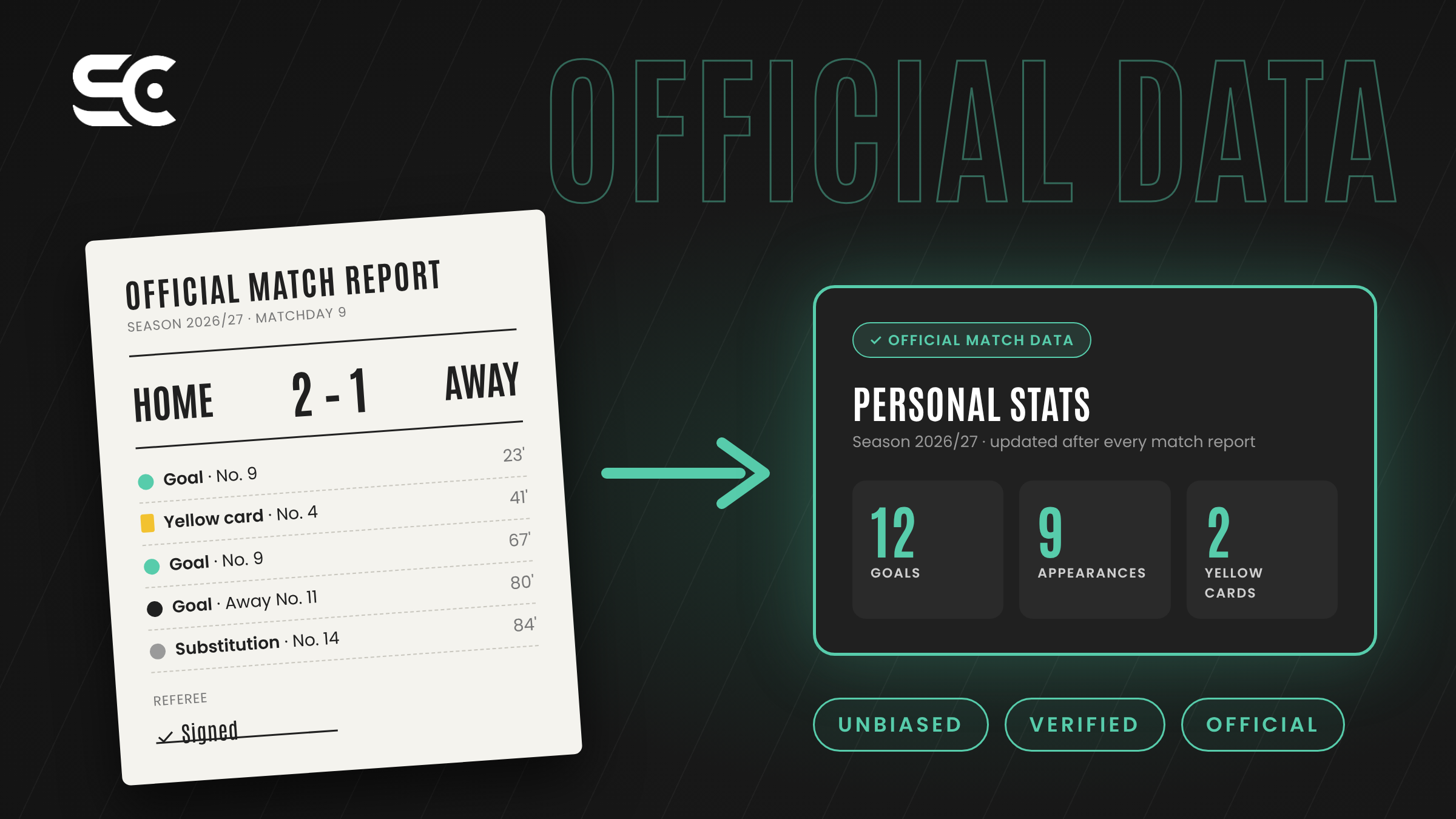
Every goal, card and appearance on a ScoutsCapital profile comes from the official match report, never from a player, a parent or a coach typing it in. That is the whole idea behind our official match stats for amateur players: if it's on your profile, it happened, and the referee recorded it, not someone with a reason to round up.
It sounds like a small technical choice. It isn't. It shapes what the app can do, what it can't, and why we think grassroots players finally deserve numbers that hold up when someone else looks at them. This is post 8 of our catch-up series, and it explains the rule we care about most.
What are unbiased football stats?
Unbiased stats are numbers that nobody involved in the result gets to edit. Not the player, not the coach, not us. In professional football analytics that's taken for granted: data companies log every action and nobody at the club rewrites it afterwards. In grassroots football, most stats either don't exist or live in a group chat, a coach's notebook or someone's memory of a Sunday morning.
When we talk about personal stats that are unbiased, we mean something simple. The record of your season should look the same whoever opens your profile, and it should come from a source with no stake in making you look better or worse. We first touched on this in Where ScoutsCapital Is Today, and this post goes into the why.
Why don't players enter their own stats?
Plenty of apps let you log your own goals, rate your own game and upload your best clips. It's quick, it feels good, and it's very hard to trust. A hat-trick you typed in yourself carries less weight than a single goal in the official record, because whoever reads it has no way of telling the difference.
Early on, ScoutsCapital leaned more on what players chose to show. You can still see that older thinking in our first blog posts, like Revolutionising Football Scouting with ScoutsCapital, which talked about videos and networking. Looking back, the weak point was trust: content a player picks for themselves is easy to scroll past, especially for the coaches and clubs players most want to impress.
Coaches' ratings have the same problem in a different shape. A coach who loves a player's attitude will see more in their game than one who doesn't. That's human, and it's part of football, but it doesn't belong in a stats line. It's also why we're careful with anything that looks like a player rating system: a rating is only as fair as the data underneath it.
Where do official match stats for amateur players come from?
After every match in the competitions we cover, the referee files the official match report. It records who played, who scored, who was booked and who was sent off. Once that report is uploaded, the data reaches the players' profiles automatically, usually within one to four hours of the final whistle.
Nobody at ScoutsCapital touches the numbers in between. We don't add a goal because a player messages us, and we don't remove a red card because it felt harsh. If the report is wrong, the fix happens at the source, the same way it would for the league table. And if a player spots something that looks wrong, they can report it through the bug-reporting tool every user has in the app.
In Madrid, that covers every adult amateur league, from Segunda Aficionado upwards, as well as youth football. Matches appear in the Matches tab week by week and results flow into profiles once the reports are in. Younger players' profiles are kept more private, with parents in control of the account.
What can official match data show, and what can't it?
Being honest about the limits matters as much as the rule itself. A match report is written for the competition, not for a scout. It is very good at the facts that decide a game: appearances, goals, cards and the result. It doesn't tell you how many passes a midfielder completed or how well a centre back read the play. There's one honest exception on profiles today: assists. Match reports don't record them, so for now a player or their coach adds them by hand. We plan to bring assists into the data we collect too, so they meet the same standard as everything else.
We'd rather show fewer numbers that are true than a long dashboard of guesses. So the profile builds on the official record instead of padding it out. Season tallies show what you've done over months, not one good afternoon. XP and achievements reward turning up and doing it again. And for Premium members, the weekly Form Score, built only from official match data, turns recent matches into a simple picture of how a player is going.
How do football scouts find players, and why does verified data help?
At grassroots level, getting noticed still depends mostly on being seen by the right person on the right day. A coach or scout from a higher level can only watch so many matches, so they lean on word of mouth, recommendations and whatever numbers they can find. Football talent identification at this level is patchy, and players in less visible leagues lose out.
Verified numbers don't replace watching someone play. What they can do is give a coach or a club a reason to come and watch. A striker with a steady season tally in the official record, or a defender who has started every week, stands out for something real. It makes squad selection with data fairer too, because a coach comparing two players sees exactly the same record either of them would.
If you've been wondering how to get noticed by football scouts, the honest answer is that consistency in the official record is one of the few things you fully control. Turn up, play, and let the report do the talking.
Where to see it for yourself
This is the rule everything else in ScoutsCapital is built on. Our walk-through of the new app and web app shows where the stats live, and why we rebuilt the app explains how we got here.
If you play in Madrid, your matches may already be in the system. Claim Your Spot at and see your season the way the match report saw it.